Understanding Search Engine Marketing (SEM)
Alright, so real talk for a second. Last month I was at a friend’s shop he sells handmade furniture, nice stuff, mostly local customers and he was complaining that his cousin’s competing shop always shows up first on Google. Always. Every single time. And I asked him, “does your cousin run ads?” and he just kind of stared at me like I’d said something in another language. That’s the gap right there. That’s Search Engine Marketing (SEM), and most business owners genuinely don’t realize how much of what they see on Google is just… paid for.
Here’s where people usually get confused, and honestly it’s a fair mix-up. SEM and SEO sound alike, they both live on the same search results page, and they both get thrown around interchangeably by people who probably shouldn’t be giving marketing advice in the first place. But they’re not the same animal at all. SEO is the slow, patient route you write good content, you clean up your website, you build trust with Google over time, and eventually (months later, sometimes longer) you climb the rankings. It works. It just takes forever.
Search Engine Marketing (SEM) doesn’t ask you to be patient. You pay, you show up. Set up your campaign this morning, and by lunch, your business could be sitting right at the top when someone searches for exactly what you sell. That’s really the whole appeal in one sentence.
Why People End Up Turning to This
I’ve had this conversation enough times now that I can basically predict what comes up.
Speed is always first. Nobody wants to wait around wondering if next month will finally be the month their rankings improve. With Search Engine Marketing (SEM), there’s no wondering your ad’s approved, it’s live, people are seeing it. Same day, basically.
Then there’s the targeting thing, which I think gets slept on way too often. You’re not just yelling into a crowd hoping the right person hears you. You get to pick show this only to people in a specific city, only on phones, only between 5pm and 9pm when people are actually home scrolling. That precision means way less wasted money on people who were never going to buy from you to begin with.
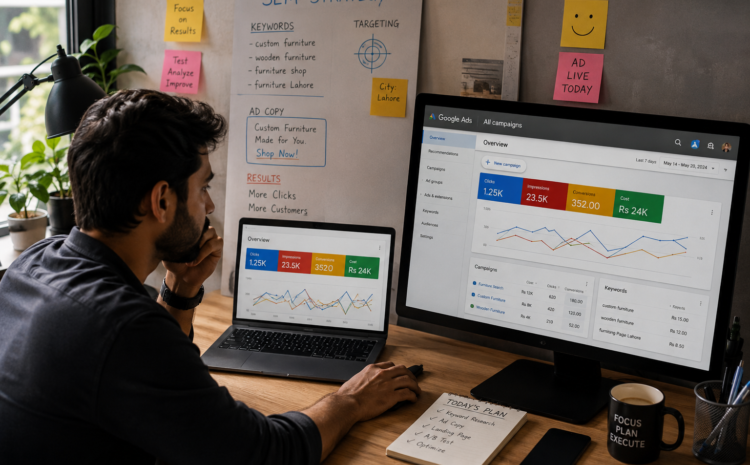
And then, the numbers. Everything’s tracked. Every click, every view, every sale that came from it. You’re not left wondering if the ad “feels” successful you just open the dashboard and look.
What Actually Separates a Good Campaign From a Waste of Cash
Here’s the bit that gets glossed over a lot running an ad is easy. Anyone can do that in twenty minutes. Running an ad that actually turns into sales? That’s a different story entirely, and it comes down to a handful of things.
Start with the right words, not the obvious ones
This is where campaigns quietly die before they even get off the ground. People guess at keywords instead of actually thinking about what their customer types. Take that furniture shop I mentioned “furniture Lahore” is one search, sure, but “custom wooden dining table Lahore” is a completely different kind of person searching. One’s just looking around, killing time. The other one’s close to buying, like, this week. Good Search Engine Marketing (SEM) starts with figuring out which of those two people you’re actually trying to reach.
Write ads that don’t get scrolled past
You’ve got maybe two seconds before someone’s thumb moves on. Two seconds isn’t much, so don’t waste it being vague or “professional-sounding” in that boring corporate way. Say what actually makes you different maybe it’s price, maybe it’s speed, maybe you’re the only shop that delivers on weekends and then tell them what to do next. “Order Now.” “Get a Quote.” Something with an actual instruction in it. Vague ads just disappear into the noise.
Don’t let your landing page ruin the whole thing
Okay so you got the click. Nice. That’s honestly the hard part done. But then what? If someone lands on a page that’s slow to load, cluttered, or doesn’t match what the ad actually promised, they’re gone within seconds. And that click already cost you money. Whatever your ad says, the landing page has to back it up immediately, no digging around required.
Keep messing with it, forever, basically
Search Engine Marketing (SEM) is never really “done.” I wish it were set it up once, walk away, collect money forever but that’s not how it goes. Keywords that worked great in March might do nothing by June. Competitors raise their bids. People search differently depending on the season, the holidays, whatever’s going on. The businesses that actually win long-term at this keep adjusting new headlines, new targeting, cutting the stuff that isn’t pulling weight.
A Small, Real-ish Example
Let’s go back to something simple a flower shop, this time in Islamabad. Somewhere across town, right now, someone just realized (with that little jolt of panic) that today’s their anniversary and they completely forgot. They grab their phone, type “flower delivery in Islamabad,” and boom with a decently set up Search Engine Marketing (SEM) campaign, that small shop is the first thing they see. Not some massive national chain with a marketing team of twenty people. Just a local shop that set things up right. That’s the real edge SEM gives smaller businesses, and it’s genuinely hard to get that kind of visibility through organic search alone, at least not quickly.
So, Where Does That Leave You
Doesn’t matter if it’s just you running things solo or a whole team behind the scenes Search Engine Marketing (SEM) puts your business right in front of people at the exact moment they’re ready to spend money. It’s measurable in a way that’s hard to argue with, it moves fast, and it bends around pretty much any budget size. If you’re tired of waiting around for SEO to eventually pay off, this is honestly a pretty solid place to start instead.
Frequently Asked Questions
-
Okay but seriously, what’s the real difference between SEM and SEO?
SEM is paid you’re literally paying for that top spot. SEO is the slower climb through content, backlinks, and site improvements. Most businesses that actually do well online end up using both, not picking one over the other.
How fast are we really talking here?
Hours, genuinely. Once your ad’s approved, it starts showing up in search results almost immediately, nothing like the months-long wait that comes with organic SEO.
Does this actually work for small businesses, or is it just a big-company thing?
It works really well for small, local businesses honestly sometimes better than for big companies, since you can target a tight area with way less competition fighting for the same searches.
How much is this going to cost me?
Depends on your industry and how competitive the keywords are. The good news — you’re always in control of your own budget and can adjust it whenever you feel like it.
Can I actually tell if it’s working, or am I just throwing money at it?
Yes, and this is genuinely one of the better parts. You get real numbers — clicks, impressions, conversions, cost per click — so there’s no guessing involved at all.