
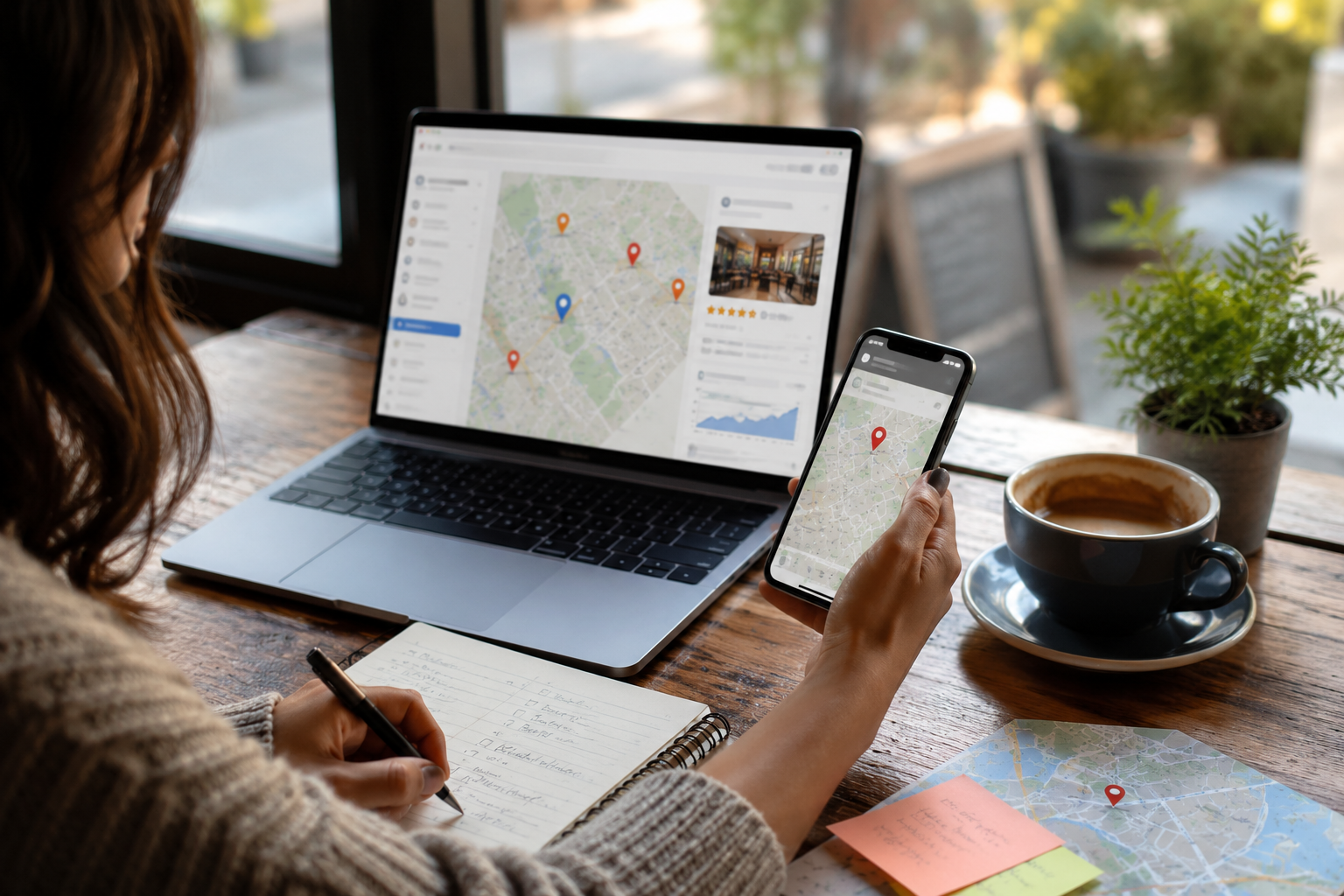
Local search in Australia looks nothing like it did two years ago. Google now answers many questions directly on the results page, pulling business names, hours, and reviews into AI generated summaries before a user ever clicks a link. A customer searching for a service no longer scrolls through ten blue links. Often they see one short answer, a map, and two or three business names, and they act on that alone.
This is why local seo services in Australia now involve far more than a Google Business Profile and a handful of backlinks. The businesses winning visibility today are the ones that understand exactly what changed and why, not the ones repeating advice from three years ago.
Google processes the vast majority of searches in Australia, more than in most other countries where competitors like Bing hold a larger share. According to Raven Labs Australia, businesses at the top of local search results receive a large share of all clicks, which means small ranking shifts carry real financial weight for local businesses.
Ready to see where your business currently stands in local search? Talk to Softcrust about your local visibility before reading further, or keep going for the full picture.
Most articles on this topic describe the shift in vague terms, calling it "the rise of AI search" without naming what actually happened. Vague explanations do not help a business owner decide what to fix first. Here is a clearer timeline of the specific changes that affected local visibility in Australia this year.
| Update | What It Did | Local Impact |
|---|---|---|
| Core Update (March 2026) | Adjusted how Google evaluates page quality and relevance | Local business pages with thin or duplicate content lost visibility |
| AI Overview expansion | Extended AI generated answers into local and map based queries | Businesses now compete to be the source AI cites, not just the top blue link |
| Google Business Profile changes | Modified review display and Q&A features | Review recency and response speed carry more weight than before |
These are not isolated events. Each one points in the same direction. Google’s own search guidelines confirm that the company continues to prioritise accurate, well structured, and genuinely local information over generic content, a principle that carries directly into how AI Overviews select which businesses to mention.
A business that updated its Google Business Profile once in 2022 and never touched it again is now at a real disadvantage compared to a competitor updating hours, posts, and responses every month. The gap between an actively managed profile and a neglected one has grown wider this year, not smaller.
Picture someone in Parramatta typing “plumber open now that fixes hot water systems” into Google. A few years ago, that search returned a list of ten blue links and a small map. Today it often returns a short AI generated answer naming two or three businesses, pulled straight from Google Business Profiles, recent reviews, and website content, with the traditional list pushed further down the page.
The business that gets named in that summary usually has three things in common. Its Google Business Profile clearly states the exact service, its recent reviews mention that specific service by name, and its website has a page that answers the same question directly.
This is the core idea behind local seo marketing services australia providers need to understand for their clients. Google is not matching keywords the way it did a decade ago. It is trying to understand what a business actually does, where it operates, and whether it can be trusted to answer a customer’s question well. Research from Whitespark’s Local Search Ranking Factors survey shows that behavioural and review signals have grown in weight precisely because they help confirm this kind of trust.
If your website says you specialise in emergency plumbing but your Google Business Profile lists a general category with no mention of emergency service, that mismatch weakens how clearly Google understands your business.
Content written to be pulled into these answers works differently than traditional blog writing. A page that states the answer plainly near the top, in normal spoken language, has a far better chance of being lifted into an AI summary than a page that buries the answer under three paragraphs of company history.
For example, a plumbing page that opens with “We repair hot water systems across Parramatta and surrounding suburbs, with same day service available” gives Google an immediate, quotable answer. A page that opens with a paragraph about the company’s founding story before mentioning any service gives Google nothing usable in the first few lines.
If your website currently opens every page with a long story about your company before answering the customer’s actual question, that structure is working against you in AI driven search.
A complete Google Business Profile remains the foundation of local visibility, and the basics still matter more than most business owners realise. Business name, address, and phone number need to match exactly across every listing, website, and directory. Even a small difference, such as “St” instead of “Street,” can weaken how confidently Google connects all your listings together.
Primary and secondary categories should reflect exactly what the business does, not a broad guess. A cafe that also does full catering should select both categories rather than relying on one. Hours, service areas, and Q&A sections need regular updates, not a one time setup during onboarding.
Beyond the profile itself, structured data on the website helps search engines and AI systems read a business accurately. A simple LocalBusiness schema addition tells Google the exact suburb served, opening hours, and service type in a format machines can parse instantly rather than guess at from plain text.
{
“@context”: “https://schema.org”,
“@type”: “LocalBusiness”,
“name”: “Business Name”,
“address”: {
“@type”: “PostalAddress”,
“streetAddress”: “123 Example Street”,
“addressLocality”: “Sydney”,
“addressRegion”: “NSW”,
“postalCode”: “2000”,
“addressCountry”: “AU”
},
“telephone”: “+61-2-0000-0000”,
“openingHours”: “Mo-Fr 09:00-17:00”
}
Adding FAQPage schema to service pages does something similar for common customer questions, increasing the chance those exact answers appear directly in search results rather than requiring a click through.
{
“@context”: “https://schema.org”,
“@type”: “FAQPage”,
“mainEntity”: [{
“@type”: “Question”,
“name”: “Do you offer same day service?”,
“acceptedAnswer”: {
“@type”: “Answer”,
“text”: “Yes, same day service is available for most suburbs in the local area.”
}
}]
}
Need help setting this up correctly the first time? See how Softcrust builds locally optimised websites that are structured for both search engines and everyday customers.
Most guides tell business owners to simply collect more reviews. That advice misses the more important detail. According to BrightLocal’s research on Google’s local ranking factors, review signals continue to carry significant weight in how the Local Pack is ordered, with recency and consistency mattering as much as the total count.
A business earning two or three genuine reviews every month sends a stronger signal than one that collected fifty reviews in a single push last year and has heard nothing since. Consistency reads as an active, trustworthy business. Silence reads as one that may have closed, changed hands, or stopped caring about its customers.
A practical approach is asking every satisfied customer for a review at the natural end of a job, rather than running one large email campaign twice a year. Small, steady requests tend to produce steadier results than occasional bulk pushes.
Replying to reviews, especially critical ones, within a few days shows both customers and search engines that the business is actively managed. Australian consumers rely heavily on reviews before contacting a business for the first time, and a pattern of calm, thoughtful responses to negative feedback often builds more trust than a perfect five star average with no responses at all.
Most local SEO content stops at rankings and clicks. There is a newer question worth asking regularly. When someone asks ChatGPT, Perplexity, or Google’s AI Overview a question relevant to your business, does your business get mentioned at all? PinMeTo’s research on local ranking factors points to this exact shift, noting that AI systems triangulate information across multiple sources rather than trusting a single listing.
Testing this is simple and free, and it takes about ten minutes. Search a handful of realistic customer questions across two or three AI tools, using your exact service and suburb. For example, “best electrician in Blacktown for switchboard upgrades.” Note whether your business appears, and where the AI tool likely pulled that information from, usually a Google Business Profile, a review site, or the business website itself.
This is not a replacement for traditional rankings. It is an additional layer of visibility that very few Australian businesses are currently tracking, which makes it a genuine opportunity rather than another task on an already long list.
Businesses with more than one location face a harder version of every challenge already covered. Inconsistent NAP details across ten locations confuse both customers and search engines. A single outdated phone number on one profile can quietly damage trust across an entire brand, even if the other nine locations are managed perfectly.
Every location needs its own accurate, complete profile, its own local page on the website, and a consistent process for updating hours and offers across all of them at once. A single spreadsheet or shared checklist, reviewed monthly, prevents the slow drift toward inconsistency that affects so many growing businesses.
Softcrust’s local SEO services are built specifically to manage this kind of consistency at scale for multi location Australian businesses, so nothing slips through the cracks as a business grows.
Australia is one of the most mobile heavy search markets in the world, with the majority of local searches now happening on a phone, often while someone is already out and close to making a decision. Quint Digital’s overview of local search in Australia notes that Australians increasingly rely on Google to find nearby products and services, compare reviews, and make quick purchasing decisions, a shift that has elevated the importance of mobile ready, accurate local listings.
A slow loading mobile site, a Google Business Profile with outdated hours, or a missing service area listing costs an Australian business real customers in real time, not just theoretical rankings on a report. Someone standing outside a closed shop because the listed hours were wrong rarely gives that business a second chance.
Search behaviour also varies slightly by state and city. Businesses in Sydney and Melbourne compete in denser markets with more established competitors, which makes accuracy and review consistency even more important. Businesses in regional areas often face less competition but need to be extremely precise about the exact suburbs and towns they serve, since broader targeting wastes visibility on searches outside their actual service area.
Is SEO still worth it in 2026? Yes. Search, including AI generated answers, still relies on the same underlying signals: accurate business information, genuine reviews, and content that clearly answers what people are searching for. The method has changed, but the value has not.
Is SEO dead now that AI answers questions directly? No. AI tools pull their answers from somewhere. Businesses with strong, accurate, well structured information are the ones being cited in those answers. SEO has changed in method, not in importance.
What are the biggest recent changes to Google’s local algorithm? The clearest shifts are the expansion of AI Overviews into local and map based searches, increased weight on review recency, and stricter evaluation of page quality following the March 2026 core update.
Who is the best SEO provider in Australia? The right provider depends on your industry, location, and budget. Businesses should look for a provider that shows clear, dated results for real clients rather than generic promises. Softcrust works with Australian businesses of different sizes, including startups looking for affordable, focused support.
Local SEO in Australia has not disappeared into AI. It has spread across more surfaces at once, including traditional Search, Google Maps, and AI generated answers. Businesses that keep their information accurate, respond to customers consistently, and structure their content to answer real questions clearly are the ones showing up across all three surfaces at once.
The businesses that treat this as a one time project, set up once and never revisited, will fall behind quietly over the coming months. The businesses that treat it as an ongoing routine, checked monthly rather than yearly, will be the ones customers actually find.
If you want a clear picture of where your business currently stands, get a local SEO review from Softcrust. This applies whether you run a single shop in Sydney looking for affordable, straightforward help or a growing startup trying to compete on a limited budget.

Tauseef Shah is the Founder of Softcrust and a digital marketing consultant specializing in SEO, Local SEO, Google Business Profile optimization, and online growth strategies.
Connect with Tauseef Shah on LinkedIn
Softcrust is one of the leading digital marketing agencies in Pakistan providing digital marketing services worldwide. We specialize in innovative solutions for businesses, offering SEO, PPC, social media, and content marketing and AI automation. Achieve your online goals with our expert team and exceptional customer service.
50 Main Sweet Grass Sweet, MT 59484 US
Floor 4th, Building 40, Sector A, DHA 2, Islamabad
+923125854438
+12136694196
contact@softcrust.info


Copyright by Softcrust 2023 |©